By Staff Correspondent
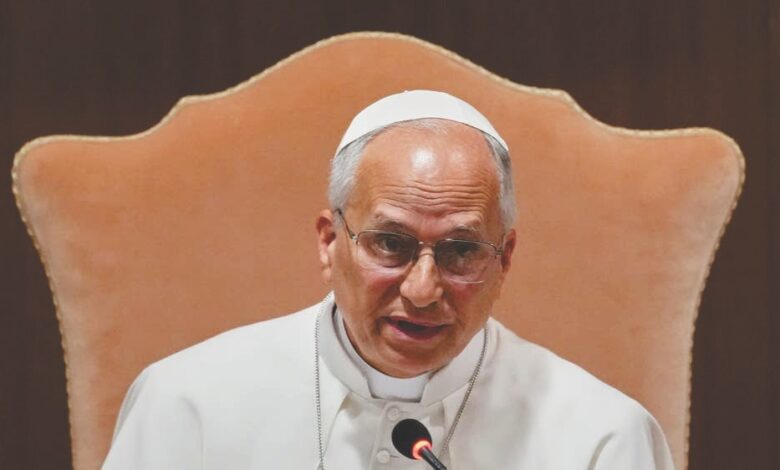
In a moment that will be remembered long in the annals of the Catholic Church, Pope Leo XIV on Monday, May 25, 2026, issued the most far-reaching papal apology ever made for the Holy See’s role in legitimising slavery, acknowledging that past Popes gave European sovereigns explicit religious authority to conquer, subjugate and enslave millions of people, and calling that centuries-long failure of conscience “a wound in Christian memory.”
The apology was delivered not as a fleeting remark but as a solemn statement embedded in Magnifica Humanitas (Magnificent Humanity), the Pope’s first encyclical, one of the highest forms of papal teaching, addressed to the Church’s 1.4 billion members worldwide. The document, whose primary focus is the protection of human dignity in the age of artificial intelligence, was released at the Vatican on Monday.
“It is impossible not to feel deep sorrow when contemplating the immense suffering and humiliation endured by so many in stark contrast to their immeasurable dignity as persons infinitely loved by the Lord,” Pope Leo wrote. “For this, in the name of the Church, I sincerely ask for pardon.”
A Distinction Without Precedent
Previous popes, including Pope John Paul II, had expressed sorrow for the involvement of Christians in the transatlantic slave trade. Yet no pontiff had ever publicly acknowledged, let alone apologised for, the institutional role that the papacy itself played in licensing that trade. Pope Leo XIV’s statement marks a decisive departure from that pattern of partial reckoning.
In 1452, Pope Nicholas V issued the papal bull Dum Diversas, which granted Portugal’s king the right “to invade, conquer, fight and subjugate” peoples of non-Christian faith wherever they might be found, and to take possession of their lands. The bull explicitly permitted the Portuguese crown “to reduce their persons to perpetual slavery.” A further bull, “Romanus Pontifex,” followed in 1455, reinforcing and expanding those permissions. Together, the two documents provided the legal and theological foundation for what became known as the Doctrine of Discovery, the theory that underpinned centuries of European colonial land seizure in Africa, the Americas and beyond.
The permissions granted by Nicholas V were subsequently confirmed or renewed by Popes Callixtus III in 1456, Sixtus IV in 1481 and Leo X in 1514, a chain of papal endorsements that the Church has never formally revoked. The Vatican repudiated the Doctrine of Discovery in 2023 but stopped short of formally rescinding the underlying papal bulls themselves.
In Magnifica Humanitas, Pope Leo directly confronted this legacy. “Already in the early modern period,” he wrote, “the Apostolic See of Rome, responding to the requests of sovereigns, intervened several times in order to regulate and legitimise forms of subjugation, and, in certain cases, including the enslavement of ‘infidels.’”
A Pope Shaped by the History He Confronted
The personal significance of the apology was not lost on observers. Pope Leo XIV, 70, is the first American-born pope in history. His own family background, which includes both enslaved persons and slave owners in his ancestry, makes his decision to confront this history all the more striking. He brought to the Chair of St. Peter a lived connection to the very wound he sought to name and heal.
The Pope acknowledged the limitations of moral retrospection. It is not possible, he wrote, to judge the decisions of centuries past by the ethical standards of today. “Yet neither can we deny or diminish the delay with which both society and the Church came to denounce” what he described as a grave offence against human dignity. He also noted, with evident regret, that his own papal namesake, Pope Leo XIII, was the first pontiff to explicitly condemn slavery but only in 1888, long after most nations had already abolished it.
From Transatlantic Tragedy to Digital Danger
The apology was situated within a broader argument in Magnifica Humanitas that the domination of human beings has never truly ceased, it has merely taken new forms. The Pope drew an explicit parallel between the transatlantic slave trade and what he called the “new forms of slavery” linked to the digital economy, warning that artificial intelligence and data exploitation risk producing fresh hierarchies of domination and exclusion. He called on the Church and the global community to resist the temptation to treat technology as a neutral force, insisting that it must always be governed by respect for the infinite dignity of the human person.
Cardinal Pietro Parolin, the Vatican Secretary of State, was present at the launch of the encyclical, alongside theologian Leocadie Lushombo and Cardinal Víctor Manuel Fernández, Prefect of the Dicastery for the Doctrine of the Faith.
Reactions to the apology began emerging swiftly from across the Catholic world. Scholars of Church history described it as unprecedented. Advocates for reparative justice welcomed it as a moral turning point. For Africa and the Caribbean, regions whose peoples bore the most devastating weight of the slave trade, the declaration carries a particular resonance.
“For this, in the name of the Church, I sincerely ask for pardon.”
— Pope Leo XIV, Magnifica Humanitas, 25 May 2026