Ghana’s Catholic Bishops open May Plenary with a call for justice, healing and moral renewal
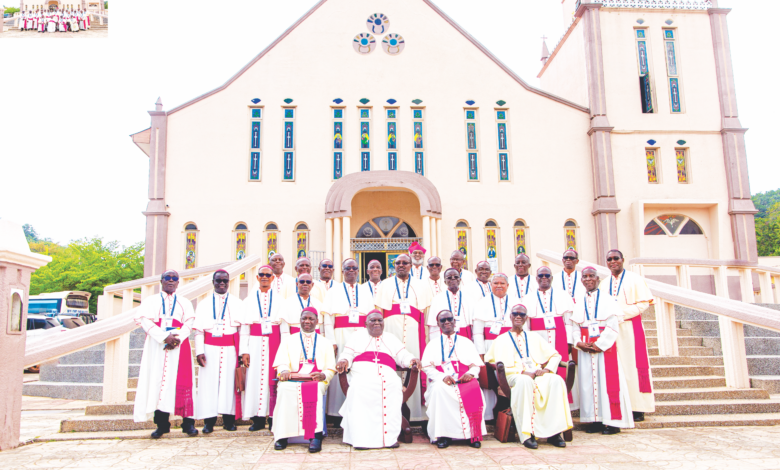
Ghana’s Catholic Bishops convened their May Plenary Assembly this week at the National Catholic Secretariat in Accra gathering under the weight of a nation still wrestling with the ravages of illegal mining, economic uncertainty, communal violence, and a crisis of public morality that continues to test the resilience of Ghanaian society.
The Ghana Catholic Bishops’ Conference (GCBC), the central body of the Catholic Church in Ghana, holds its Plenary Assemblies to deliberate on matters of concern to the Church and to encourage activities in accordance with the needs of the times. This May session brings together all the Bishops of Ghana’s Dioceses under the presidency of Most Rev. Matthew Kwasi Gyamfi, Bishop of Sunyani Diocese and Vice President Most Rev. Emmanuel Kofi Fianu, SVD, Bishop of Ho Diocese.
The Assembly opened with a solemn Mass, as has been the tradition at GCBC plenaries, before the Bishops entered into closed deliberations expected to span several days. Sources close to the Conference indicate that the agenda encompasses a broad sweep of pastoral and national concerns, including the Church’s educational apostolate, priestly formation, synodal processes at the diocesan level, and the increasingly urgent environmental crisis wrought by galamsey.
The timing of this plenary could not be more pointed. Just days ago, at the national May Day celebration in Koforidua, the Chairman of the Trades Union Congress sounded an alarm that echoed the Church’s own longstanding concerns. “The issue of galamsey still remains a menace and must stop now. Despite ongoing reforms, we are losing this fight, and we cannot afford to lose our future,” he warned, noting that the environmental destruction caused by illegal mining poses a serious threat to jobs, livelihoods and the country’s future.
The Bishops are well acquainted with this terrain. At their November 2025 plenary, held in the Diocese of Damongo under the theme: A Synodal Church at the Service of Justice and Peace in Ghana, Bishop Gyamfi expressed grave concern over environmental degradation caused by illegal mining, pointing out that large areas of forest have been destroyed, rivers polluted, and ecosystems damaged due to irresponsible mining practices. That same assembly raised the alarm over rising inflammatory and ethnocentric rhetoric threatening Ghana’s social cohesion and peace, drawing attention to ongoing conflicts in Bawku, Gbenyiri, Kalba, Bole, and Nkwanta South, which have led to loss of life, displacement, and societal disruption.
Six months on, these concerns have not abated. Labour leaders at this year’s May Day parade warned that illegal activity in forest and river bodies continues despite the revocation of the legislative instrument that had permitted mining in forest reserves, with the TUC Secretary General cautioning: “If we do not stop galamsey, Ghana will not have rivers in the next few years.”
On the economic front, Ghana shows signs of recovery — real GDP expanded by 6% in 2025, driven by services and agriculture recovery, with headline inflation falling to 3.3% in February 2026 due to cedi appreciation and fiscal and monetary policy tightening. Yet President John Dramani Mahama has himself acknowledged that economic stability is only the foundation, stressing that the real priority must now be to improve the lives of citizens through jobs and growth.
It is precisely this gap — between macroeconomic indicators and the lived reality of ordinary Ghanaians — that the Church has consistently sought to bridge. The bishops reiterated at their last plenary that education plays a vital role in national development and unity, calling for a clear partnership framework between the government and the Church to effectively manage Catholic mission schools while safeguarding their spiritual and moral integrity. They also appealed for at least 20 percent of admissions in Catholic pre-tertiary schools to be reserved for Catholic children.
The Bishops’ Conference is also expected to address the deepening need for formation within the Church itself. The Conference has emphasised the need for increased formation for clergy, religious, and laity in areas such as leadership, conflict mediation, social analysis, and Catholic Social Teaching, with the Directorate for Governance, Justice and Peace tasked with collaborating with Catholic universities and seminaries to develop comprehensive synodal formation programmes.
A communiqué from the plenary is expected at the close of the Assembly and will be published in full in a forthcoming edition of The Catholic Standard.