By Diana Afeku
The Catholic Church in Ghana has called for stronger safeguards around Artificial Intelligence (AI), warning that the technology’s rapid growth must not come at the expense of human dignity, social justice or the welfare of vulnerable people.
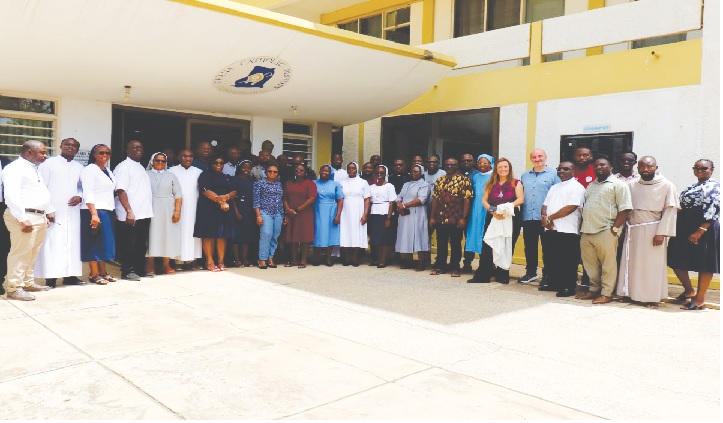
The call followed a three-day workshop on the theme: Artificial Intelligence: A Catholic Perspective From Ethical Principles to Critical Use, held at the National Catholic Secretariat in Accra from May 19 to 21, 2026.
The event was organised by the Ghana Catholic Bishops’ Conference (GCBC) in collaboration with the Symposium of Episcopal Conferences of Africa and Madagascar (SECAM) and the Ethical Artificial Intelligence for Human Development (EAiD) initiative under the Vatican Dicastery for Promoting Integral Human Development.
The workshop brought together Church leaders, academics, educators, communicators and development practitioners to examine how AI is reshaping society and what the technology’s rise could mean for Ghana, the Church and the wider African continent.
Sessions facilitated by Ms. Maria Amparo Alonso and Mr. Luca Baraldi of EAiD focused on data privacy, algorithmic bias, AI governance, human rights and the ethical use of emerging technologies.
Participants also discussed the six principles of the Rome Call for AI Ethics, a non-binding commitment backed by governments, technology companies and religious institutions to promote the responsible use of artificial intelligence through transparency, inclusion, responsibility, impartiality, reliability, security and privacy.
The facilitators cautioned, however, that “ethical principles do not automatically resolve all conflicts. Real-world situations will frequently generate tensions that require careful, conscious discernment.”
A major concern throughout the workshop was the growing spread of misinformation and AI-driven fraud, including the increasing use of deepfake videos, voice cloning and phishing schemes targeting churches and humanitarian organisations. These have included fake fundraising campaigns and the impersonation of clergy. The workshop stressed the need for stronger verification systems and improved digital literacy within Catholic communities to help prevent abuse of the technology.
Participants also turned attention to what they described as the less visible side of AI, from the minerals used in building digital infrastructure to the labour behind data labelling and content moderation. They noted that these systems often rely on workers and supply chains that remain largely hidden from public view, despite their serious social and ethical implications.
Concerns were raised as well about Africa’s place in the global AI landscape. The facilitators warned that without stronger involvement in innovation, data governance and technological development, African countries risk becoming dependent on systems designed and controlled elsewhere.
Ghana’s proposed National Artificial Intelligence Strategy (2025–2035) was welcomed as an important step toward building an AI-driven economy through investment in research, education, infrastructure and data governance. the facilitators urged caution, however, against over-dependence on foreign technology platforms and the unchecked use of local data by outside interests.
The workshop also explored how AI tools could support Catholic institutions in areas such as administration, education, communication, research and pastoral care provided human oversight and accountability are maintained throughout.
Ms. Alonso stressed that AI-generated material should never be accepted at face value, noting that content which appears convincing or polished could still contain inaccuracies or misleading information.
The meeting concluded with participants drafting recommendations for how Catholic institutions in Ghana should manage and regulate the use of AI in their operations. They called on the Church in Africa to play a more active role in global conversations on AI ethics and to advocate for technology that serves people and communities rather than narrow commercial interests.