The Role of St. Theresa Centre for Physically Challenged
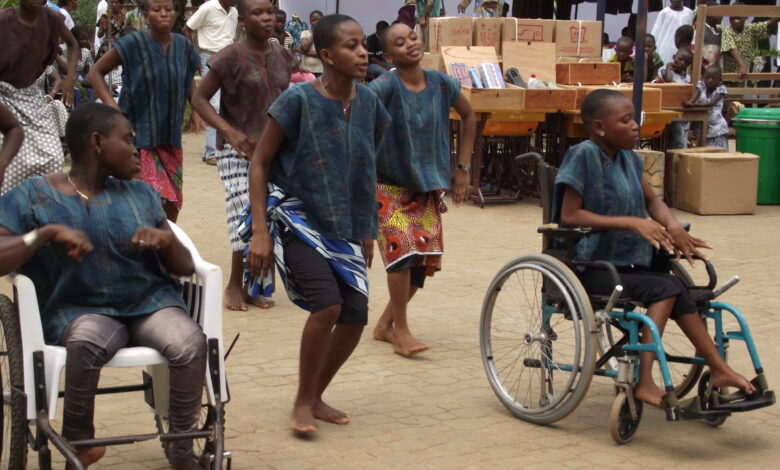
The saying that “disability is not inability” is always manifested when some persons with physical disability yearly graduate from St. Theresa Vocational Training Centre for the physically challenged at Abor in the Keta-Akatsi Diocese.
 It is always a joy when people have the experience in the field of the physically challenged which leads to a new apostolate in the world of the vulnerable.
Disabilities have been defined in many ways. In general, disabilities are characteristics of the body, mind, or senses that affect a person’s ability to engage independently in some or all aspects of daily living.
Different kinds of disabilities affect people in different ways yet, the same kind of disability can affect each person differently. While all disabilities are as different as the individuals who experience them, the challenges and opportunities for persons with disabilities are often similar.
Disability is not “inability” or “sickness”
People living with disabilities can be as healthy as those without them. People with disabilities can work, play, learn and enjoy full healthy lives in their communities.
During the 25th and 40th anniversaries respectively of St. Theresa Vocational Training Centre and St. Agnes Vocational Training School in 2015, speakers repeatedly drummed into the ears of the physically challenged that disability is not inability and asked them to show to the world they were able because they had been empowered.
 The two Institutes are run by the Congregation of the Servants of Charity (Guanellians), a Catholic Religious Congregation founded by St. Louis Guanella, whose passion for the poor and the less privileged resulted in the birth of the Congregation.
The members of this Congregation; Priest, Rev. Brothers and lay people are popularly known and addressed as the Guanellians, a name they had after their Founder. They do generally charity oriented work, that is centred on rehabilitating the mentally and physically challenged and the caring for elderly persons and the less privileged in the society.
The Institutes have Rev. Fr. Leonard Emeka Owumanam, SC, as the Superior of the Guanellians at Abor, and Rev. Fr. Isaac Nwagboso, SC, as the Administrator of the St. Theresa Vocational Training Centre and St. Agnes Vocational Institute.
As of last year, St Theresa Vocational Training Centre for the Handicapped had 125 students among whom 53 are physically challenged.
The theme of the graduation ceremony Disability and Development: The Way Forward, according to the Administrator, Fr. Nwagboso, was chosen with the vision to move on with the current issues on disability marshaled out by the United Nations to seek more development for people with disability. This project is the Disability Inclusive Development Agenda Towards 2015 and Beyond. The focus is to recognize persons with disabilities as agents and beneficiaries of development, acknowledging the value of their contribution to the general well-being, progress and diversity of society.
 To realize this goal, it has been suggested that there is the need to recognize the right to education on the basis of equal opportunity and non-discrimination by making primary education accessible, free and compulsory, and available to all children with disabilities on an equal basis with others.
Ensuring that all children have equal opportunity for access to an inclusive education system of good quality and making early and secondary education generally available and accessible to all, in particular to children with disabilities from low-income family. The Administrator of the School re-ehoed the need for the graduating students to be dedicated, determined and disciplined in all their endeavour as they were going into the world to exhibit the knowledge they had acquired.
St. Theresa Centre
This is adage that, “Nothing great will ever be achieved without great men and women, and men and women are only great if they are determined to do so.”
The St. Theresa Centre was started in 1989 by Rev Fr. Angelo Confalonieri of blessed memory, an Italian Comboni Missionary, with some support from his friends in Europe, Canada, the Netherland and Ghana.
It is a non -profiting organization officially commissioned on April 29, 1989 by Lt. Gen. Arnold Quainoo, built for the rehabilitation and offering of vocational skills to the physically challenged persons in Ghana under the then Keta- Ho Diocese, now Keta-Akatsi Diocese.
The St. Theresa Vocational Training Centre for the Physically Challenged has on record to have trained about one thousand seven hundred and eighty (1,780) students in these past years.
 Worthy of note is the fact that the Centre has a well-equipped physiotherapy Department as well as a Leatherworks Workshop for the manufacture of orthopedic apparatus. The students of the Centre as well as patients from outside benefit from the services these Departments render.
Students of the Centre who are in need of orthopaedic surgery are identified and their cases studied. The surgeries are chiefly done to enable the crippled people to make use of prosthesis and crutches. The rehabilitation process is done at the Centre after surgery. This service is also given to outsiders in need. Besides the physiotherapy programme, there is an infirmary where students receive first aid treatment.
The Centre has some other facilities such as the administrative building, classroom blocks, broadloom weaving workshop, dressmaking, tailoring,, radio/television, computer workshops as well as printing press laboratories, dining hall and kitchen, separate dormitories for boys and girls, Chapel, assembly hall, staff hall, social welfare office, some stores and garages.
The St. Theresa Centre cultivates and maintains the culture of self-sustenance in the area of food production by embarking on small scale animal husbandry projects like poultry, piggery, honey production, growing of crops such as maize, groundnuts, cassava, vegetables, and so on. Eggs, honey and meat produced at the Centre to serve as food supplement in the diet of the trainees and whatever remains is sold to the public.
 The primary objective of this School as a Rehabilitation Centre is the exposure of the deprived segment of Ghana’s population to basic skill acquisition so as to help them reach a high and appreciable level of self-reliance by fostering their moral and social integration into the society to which they naturally belong.
These objectives are being pursued through the spirit of the Guanellian Congregation which anchors in unconditional merciful love to the less privileged irrespective of religious, tribal or racial affiliation or even social status. Blessed Father Louis Guanella rightly stated that “we can never rest as long as there are the poor to be helped.”
St. Agnes Vocational Institute
It is popularly said that, “it is men and women of ideas that rule the world”. The institution which celebrated its 40th anniversary in 2015, came into reality with the idea of Mrs. L.C.H Dorge, who nursed the idea of offering young girls in various villages and across the southern part of Volta Region a Centre for vocational training. The target group was especially those who had no means to enter any formal education.
This idea was shared with Rev. Sr. Gabriel of Sacred Heart Clinic, now a Hospital at Weme and finally was proposed to the then Bishop of Keta – Ho Diocese, who gave his consent. Consequently, with the land donated by Torgbi Dallah III of Weme in 1973, the foundation of the Institution was laid.
The Centre was handed over to the Guanellians by the Catholic Diocese of Keta-Akatsi in January 2008.
The vision of the Centre had been to offer young people employable skills and introduce them to formal education and at the same time subject them at their own level, into the production and marketing of their products.
The Centre started with eight trainees in 1974. More trainees in the course of the year expressed their desire to join the training programme. And since then, a regular enrolment of students has continued. The School each year takes care of about 60 students in two main vocational training: Dressmaking and Catering for three to four years with an intensive theoretical and practical training.
At the end of the training, National Vocational Training Institute (NVTI) Proficiency Certificate is awarded those who are trained to be proficient in their chosen career, while the NVTI Certificate 1 and 2 are meant for those who write foundation Examination that includes: English Language, Mathematics, Entrepreneurship and Integrated Science. This Certificate together with the NABPTEX examination enable them to be admitted to the Polytechnics.
The Centre right from onset was meant to train girls and ladies from indigent families in a vocational trade with the possibility of becoming self – reliant thereby creating an opportunity for economic independency. Most importantly to train them in order to liberate them from any form of exploitations that can be induced through poverty of the mind, poverty of the pocket and consequently poverty of morals.
Mentally challenged
The Congregation of the Servants of Charity is equally running the Guanellian Centre for the mentally challenged children who their founder, St. Father Louis Guanella called, “I buoni figli” which means the good children.
The Centre was commenced owing to the need to rehabilitate and take care of the mentally retarded children in the area in which the congregation is situated since no centre of a sort is found in that vicinity from Aflao to Battor and up till Hohoe. The Congregation has a plan of transferring this particular Centre to Adidome in the near future by the grace of God.
The Disability Bill/Law
In Ghana over the years, disabled people’s organisations kept up the profile of the Disability Bill through annual celebrations such as International Disability Day and Human Rights Day. In fact, at the International Disability Day celebrations in 2005, the Minister of Manpower Development and Employment confirmed the government’s commitment to disability issues, and declared the year 2006 as “Year of Action on Disability”.
The Parliament of Ghana passed the Persons with Disability Bill on June 23, 2006 which aims at enabling disabled people to “enjoy rights enshrined in the Constitution (Article 29 (8)) with the view to improving their living standards and mainstreaming their activities”.
The Bill which was first drafted in 2002 and went through to 60 amendments during this four year period (2002-2006) finally went through with the blessing of both the Majority and Minority Members of Parliament. The Bill aims to provide disabled people with: Accessibility to all public places, Equal employment opportunities, Transportation at free or reduced costs, free, general and specialist medical care, the creation of desks specifically for disabled people at employment centres and a National Council on Persons with Disability to oversee the implementation of national programmes aimed at disabled people.
The Act offers a legal framework to protect the rights of physically and mentally disabled persons in all areas of life, from education, training and employment to physical access and health care. It is also intended to promote the creation of an environment that will advance the economic well-being of disabled people and enable them to function better. But ten years after passing the Bill into Law, one would ask how it had been beneficial to the beneficiaries.
According to the Deputy Minister for Gender, Children and Social Protection, Mrs. Dela Sowah, during the Graduation Ceremony at Abor on July 17, 2015, the Government of Ghana was committed to the promotion and protection of the rights of People Living with disability to live within their communities and ensure the equalization of opportunities.
“In this regard, the Government has directed that two per cent of the District Assembly Common Fund at the respective District Assemblies should be ceded to people living with disabilities,” she said.
Rev. Fr. Leonard Emeka Owumanam, SC, in a presentation at the ceremony said the significance of the educative value of St. Theresa is to give credence when we consider the result of the survey done by UNESCO that 90 percent of children with disabilities in developing countries (Ghana included) do not attend School. They are abandoned and left at the mercy of ignorance. Hence, their education becomes of paramount importance.
“We try to guarantee that persons with disabilities enjoy their inherent right to life and education on an equal basis with others, ensure the equal rights and advancement of women and girls with disabilities and protect children with disabilities.”
On the fundamental issue of accessibility, St. Theresa tries to identify and eliminate obstacles and barriers and ensure that persons with disabilities can access their environment, transportation, public facilities and services, and information and communications technologies.”
Achievements
Ss. Theresa and Agnes in the course of their 25 years and 40 years of establishment respectively, have trained more than two thousand four hundred (2,450) persons, who are now working in different of parts of our country and even abroad. Speaking of St Agnes, the current Vice Principal of the School, the Bursar of St. Theresa are all ex-students of St. Agnes.
There is also one former student who is working at Fafa FM at Dzodze, another is a Director of an oil station at Ziope, one at Aflao has her personal dressmaking industry with about 15 apprentices, three are Reverend Sisters, one is in one of the Religious Congregation in Nigeria, one is in Ho Diocese and the other at Elmina in the Cape Coast Archdiocese Dioceses, while about five are working out-side the country. Many are working in different hotels and industries within the country.
From St. Theresa, there are many old students of St. Theresa,who are in good positions in different offices in the country. The current Vice Principals are products of the institution, together with three other Instructors. Mr. Ben Ajodo is an Assistant Technician at Ghana Broadcasting Corporation, Mr. Johnson working at Ghana Telcom Accra; some are Secretaries in different Districts and private sector. There also four ex-students currently pursuing advanced studies at Ho Polytechnic.
With Projects, St. Theresa has entered into partnership with Ghana government through GIZ, a German organization and currently training 15 persons for them in electronics in order to improve the skill development initiative in Ghana. The Ghana Electronic Association is also working with St. Theresa presently to ensure the training of persons on the modern electronic exigencies.
Conclusion
People with disabilities in Ghana are often regarded as unproductive and incapable of contributing in a positive way to society. Instead of being viewed as assets, they are rather seen as constituting an economic burden on the family and the society at large, which leaves them in a vicious cycle of poverty. In developing countries, there are rarely strong disability movements actively working to improve the living conditions for people living with disabilities. Disabled persons are often only weakly represented in civil society and Ghana is no exception.
To help protect their rights, the UN General Assembly adopted the Convention on the Rights of Persons with Disabilities in December 2006. The Convention and an additional optional Protocol are intended to promote, protect and ensure the full and equal enjoyment of all human rights and fundamental freedoms for all persons with disabilities.
The fight against social vices like violence, unemployment, terrorism, sexual abuse and illiteracy, cannot be adequately put on focus and combated without considering these vulnerable groups. Hence, the successes achieved so far by these two Centres worth more and celebration.
All hands must be on deck to support the Church and the government in promoting the welfare of these institutions and others like them.
The Students have celebrated success, victory and triumph over all forms of societal discrimination and segregation on persons with disabilities. They gathered to celebrate the contribution of the Catholic Church towards human development and her indebtedness to humanity irrespective of socio – economic, cultural, political affiliation, physical and psychological status. Integral development of all people (Populorum progressio) is one of the goals of the Church and her gift to the human society.
The significance of the educative value of St. Theresa is giving credence when one considers the result of the survey done by UNESCO shows that 90 percent of children with disabilities in developing countries (Ghana included) do not attend school. They are abandoned at the mercy of ignorance. Hence, their education becomes of paramount importance.
The St. Theresa and St. Agnes Schools strive to guarantee that persons with disabilities enjoy their inherent right to life and education on an equal basis with others, ensure the equal rights and advancement of women and girls with disabilities and protect children with disabilities.
According to the CONVENTION on the RIGHTS of PERSONS with DISABILITIES organized by the United Nations (UN) in 2006, research indicates that violence against children with disabilities occurs at annual rates of at least 1.7 times greater than for their non-disabled peers. Hence, the need to offer the fundamental human protections to these most vulnerable persons in our society.
As the saying goes that “Rome was not built in a day”, so did it take the Comboni Priest, Rev. Fr. Angelo Confalonieri of blessed memory and the Congregation of the Servants of Charity days and years to make St. Theresa Vocational Institute for the Handicapped not only a reality but an enviable place for the assurance of the future of young people who society may have abandoned.