The Role of Matthew 25
The battle against HIV and AIDS is our battle. If you are not infected, you are affected in one-way or the other. Let us change our behaviour to uphold our dignity as people created in the image and likeness of God.
Introduction
Persons Living with HIV and AIDS (PLHWAs), would always be grateful to Rev. Msgr. Alex Bobby Benson, founder and Director of Matthew 25 House at Koforidua for his support and care over the years.
Matthew 25 House is a Non-Governmental Organization (NGO) in Ghana, aimed at helping those infected with and affected by HIV and AIDS as well as giving aid to Orphans and Vulnerable Children (OVC).

Already, the Catholic Church in Ghana has over the years been campaigning against the spread of the deadly disease, through its Centre for Human Development (CEHUD) Department of the National Union of Ghana Diocesan Priests’ Association as well as home-based care programmes for people living with the pandemic through Catholic Health Institutions at Agomanya, Nkawkaw, Kumasi, Koforidua, among others.
But there are still many areas uncovered which will need the support of benefactors and benevolent donors. One of the saddest things that can befall any human being is to be neglected and ostracized by either family members or society or both as a result of sickness or mishap.
Matthew 25’s impact
“For I was hungry you gave me food, I was thirsty and you gave me drink, a stranger and you welcomed me, in prison, you visited me… what you do to the least ones you did it for me” (Matthew 25:31-40). Matthew 25 had accomplished this quotation which inspired its formation by providing practical solution to the problem of HIV and AIDS victim.
Matthew Chapter 25, is a formidable partner in the fight against HIV and AIDS to help check the spread of the pandemic, offer care and support to People Living with HIV (PLWHIV) and their orphans whilst sensitizing them to be bold and go out to tell the world the disease is real.

In doing that, PLWHIV are encouraged to feel that they were also human beings and see the disease as any other ailment which can befall man. Many a time when people get infected by the disease they are sadly rejected and neglected by family members and friends.
According to Msgr. Bobby Benson, a Priest of the Koforidua Diocese in Ghana, “Society forgets that the disease is no respecter of persons and that anyone can fall prey irrespective of one’s social, political, religious or economic background.”
The idea of the establishment of Matthew 25 was conceived in 1996 when Msgr. Benson was studying in the United States of America (USA) as a Student Chaplain, where two people living with HIV were brought to him and his colleagues in one of their classes.
“I was touched so much after they had spoken to us and I hugged them, sat and chatted with them. It was then that I realized that people living with HIV were also humans, who needed to be encouraged in diverse ways. Before this moment, I had said I will not get nearer them because I was afraid but my action broke the barrier”, Msgr. Bobby Benson said.
When he came back to Ghana in 1997, remembering the experience he had when in the USA, he decided to help in his small way to form support base by opening a Centre at the old Parish Hall of St. Anthony Catholic Church at Akwatia where he was then the Parish Priest and christened it Matthew Chapter 25 Project, which started in 1999 with nine HIV patients who met every Thursday at the Parish Hall and later increased to 20. Now the number is 90.

At the time, Rev. Sr. Miguela Keller, Primary Health Care Co-ordinator of St. Dominic Hospital at Akwatia where Msgr. Benson was posted to, had already started a programme by meeting with PLWHIV and offering them herbal medicine free of charge.
As the number grew, a new Centre was acquired at Koforidua where PLWHIV meet to be counseled by resource persons, given nutritious food, medical care, support for Orphans and Vulnerable Children (OVC), and engagement of the PLWHIV in incoming generating ventures like batik tie and dye, processing cassava for gari, palm oil extraction and funeral undertaking.
The effort of Matthew 25 House was so timely because interestingly, the Eastern Region of Ghana where the Matthew 25 House is located has for some time now topped the Regional prevalence, even though the national prevalence had reduced according to the 2008 sentinel Survey Report.
Some PLWHIV felt rejected by families and society while others felt they had no future, no hope, distressed but, alas, Organizations like Matthew 25, and the Catholic Health Service through its numerous HIV and AIDS programmes have indeed helped to reverse the negative perception people have about people living with HIV. What Matthew 25 is doing is not enough at all, many more help is needed to save the situation.
It is time for people to know that PLWHIV have talents, capacities, privileges, intelligence and opportunities. However, these will remain largely untapped unless opened through their (PLWHIV) own decisions and efforts towards a common voice in advocacy to enhance the general being (human rights, care and support) of the infected and affected families.
This will in turn help to further reduce the spread of the HIV infection in Ghana through sharing of personal experiences on positive living, education and counseling of people on Voluntary Counseling and Testing (VCT).
Matthew 25 House is where people infected with HIV and AIDS and had been rejected by their families are provided with shelter, food, medical care and support for their children through education and skill training to ensure a livelihood for them to reduce their dependency on the House and charity.
Care and Support
Many persons infected with the virus over the years have had to live with it ignorantly whiles those who had gone through the counseling and testing processes either voluntarily or because of the frequent ailment have had to keep their status as a secret or suffer rejection, discrimination and stigma from the society.
Society including families, workplaces and even Churches have failed to accept people living with HIV and AIDS.

Many people who rather needed care and support in their critical moments in life have been left to suffer alone eventually leading to death while their children and spouses particularly wives have suffered highest and varied forms of dejection, pain and stigma.
HIV and AIDS can render people lonely and helpless, shortening the life span of victims. As a solution, Matthew 25 offers various forms of care and support services to people living with the pandemic.
They meet at the Matthew 25 House to interact, encourage one another, and share various experiences as to how best to manage the disease ensuring a longer life span.
Many lose their jobs when employers realise they are infected or cannot continue working due to their illness. At Matthew 25, they receive counselling and engage in income generating ventures.
Many children have been orphaned through AIDS and as a result have had their lives crushed at earliest ages because nobody wants to associate with children and persons whose immediate relations have been infected by the HIV or worst of all died from AIDS.
Matthew 25 House caters for the transport of the patients who had come from far and near and distributes food items to them to cater for them for the month.
Supported with staff, Msgr. Bobby Benson ensures that all those who come to the House are put on the Anti-Retroviral drug (ART) when they are due, given medical care, fed, clothed, sheltered and provided with educational needs and counseling.
People who came to the House very sick and skinny because of lack of ART and medical care to manage the other opportunistic infections like tuberculosis, skin rashes, diarrhea, and others, in no time recovered to normal state and were able to go about their duties except that they could not divulge their secret to their families.
The House in furtherance of its objective, established the Clinical Pastoral Education (CPE) as a subsidiary of the House at Koforidua to train Seminarians, Priests and Religious and other lay persons in handling the sick, especially to know more about HIV and AIDS and how to care for them to reduce stigma in the society.
It also organizes a “soup kitchen” every Christmas for PLWA’s groups across the region and fetes other vulnerable in the society such as those in Hospitals and Police cells.
The House has also instituted a pre-valentine programme to educate house helps and trade apprentices to create awareness of the HIV and AIDS and the several modes of transmission and the need to stay clear of attracting the virus.
According to Msgr. Bobby Benson people who had been diagnosed with the disease go through a lot of trauma which even killed them earlier than the disease. Stigma and fear of rejection from their families and the society in general is also part of it. HIV and AIDS was part and parcel of humans and so must be seen as any other disease.
He has always been grateful to the Catholic Church and all its Bishops, particularly the Koforidua Diocese, who had allowed him to run the House and its program in the diocese and all those who over the years had supported the House to achieve its purpose guided by the Gospel of Mathew 25:35-40 where Jesus said “when I was hungry you gave me food, naked you clothed me, in prison you visited me and when sick you cared for me, what you did for one of my least ones you did it for me.”
HIV and AIDS Education
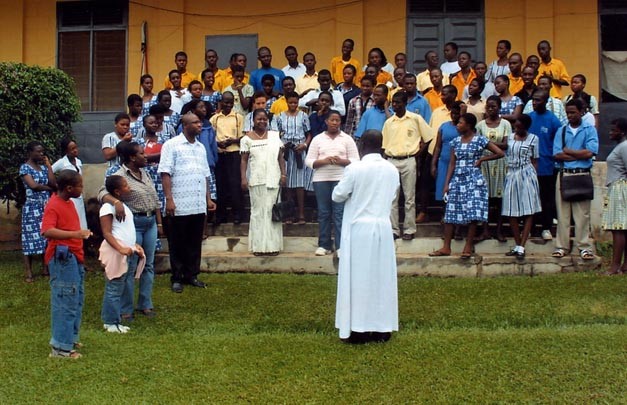
As part of its educational campaign against HIV and AIDS, Matthew 25 has established Youth Alive Clubs in Senior High Schools in the Eastern Region, where they are trained to become peer educators and counselors.

They attend workshops during which students are given talks on friendship and relationships, boy and girl friend relationships, their sexuality, career guidance, sexually transmitted infections (STI), peer pressure, drug abuse and teenage pregnancy.
These Clubs are used in raising awareness among the youth on how deadly HIV and AIDS is and its prevention. Participants in these programmes learn to abstain from early sexual activities and make informed decisions.
Priests’ effort to fight HIV stigma
Priests of the Catholic Church in Ghana during their Biennial Congress at Ho in 2013, resolved to be more involved in the campaign against the spread of HIV/AIDS and in the pastoral care of People Living with HIV/AIDS. They pledged to educate our communities against their stigmatisation and to form sustainable support groups for them.
Desirous of facing these challenges with appropriate pastoral responses, Priests adopt the resolutions to live with ever greater commitment the evangelical counsels of obedience, poverty and celibate chastity as a radical witness to the life of Jesus and as a path to priestly holiness.
Impact of HIV
Since HIV and AIDS was discovered in Ghana in the late 1980’s, the fear and stigma attached to it has not reduced because of the perception that one could only acquire the disease through promiscuity and the fear that once infected one would eventually die because there is no cure for it.
Many persons infected with the virus over the years have had to live with it ignorantly whiles those who had gone through the counseling and testing processes either voluntarily or because of the frequent ailment have had to keep their status as a secret or suffer rejection, discrimination and stigma from the society.
Society including families, workplaces and even the Church has failed to accept people living with HIV and AIDS.
Several years have seen significant inroads, with life-prolonging drugs, more funds for prevention and treatment, more knowledge leading to increased awareness and openness and less stigma. Such developments may lead some to wonder whether HIV and AIDS – of all the urgent challenges facing Africa – still deserve privileged attention. HIV and AIDS continues to be the leading cause of death in the continent, home to 22 million HIV-positive or two-thirds of the global total of 33 million, according to 2007 Report.
In the developing world, although improved access to antiretroviral therapy means that fewer people are dying, treatment is reaching less than one-third of those eligible.
The number of AIDS orphans has swollen and their myriad needs are scarcely being met. Millions in Africa are still mired in deprivation and ignorance that put them at high risk of contracting HIV, as much dedication as ever is needed to turn the tide against the pandemic. Yet why dedicate energy, resources and expertise to what seems one problem among so many?
National prevalence
A new survey conducted by the Ghana AIDS Control Programme has revealed that urban areas in the country have the highest prevalence rate of HIV/AIDS. This was made known recently to Journalists and other interest groups ahead of the recent publication of the 2013 surveillance results of the national HIV/AIDS prevalence rates.
It is estimated that about 1.85 percent of Ghana’s population is infected with the disease, which is most prevalent in Eastern and Volta Regions with the Northern Regions recording the lowest, according to the survey.
However, an estimated HIV prevalence rate presented by the National AIDs and Sexually Transmitted Infection] (STI) control programme revealed that there has been a decline in prevalence rate from 1.85 percent to 1.3 percent in 2013.
The national HIV prevalence rate fell to 1.6 percent in 2014 from 1.9 per cent in 2013, the HIV Sentinel Survey has revealed.
The prevalence rate has dropped three times in previous years; first in 2005, 2008 and 2014. According to the Survey, the Regional HIV prevalence ranged from a high of 3.7 per cent in the Eastern Region to a low of 0.6 per cent in the Northern Region. The HIV Sentinel Survey is a cross sectional survey targeting pregnant women attending Antenatal Clinics (ANC) in selected ANC sites in Ghana.
In the last nine years, the HIV Sentinel Survey (HSS) data has been used as the primary data source for the National HIV and AIDS estimates in Ghana. The HSS Report thus presents prevalence among pregnant women.
Dr. Stephen Ayisi Addo, the Acting Programme Manager of the National AIDS Control Programme (NACP), who presented the Report, said the 2014 Survey was the 23rd of such Reports since its inception. The Survey said site prevalence ranged from 0.2 per cent in Nalerigu in the Northern Region to 8.5 per cent in Agomanya in the Eastern Region.
He said the urban median HIV prevalence was higher than rural (2.0 percent compared to 1.1 per cent) and urban mean HIV prevalence was also higher in urban than rural locations (2.8 per cent compared to 1.4 per cent).
The HIV prevalence among the young population (15-24 years), a proxy for new infections, increased from 1.2 per cent to 1.8 percent with proportion of HIV subtype 1 as 96.2 per cent compared to 1.9 percent for both sub-type 2 and dual infection in the 2014 survey.
HIV prevalence amongst STI clients is 4.2 percent and syphilis prevalence amongst STI clients is 0.6 per cent.
A linear trend analysis of Antenatal Clinics HIV prevalence since 2000 shows a declining epidemic, Dr. Ayisi Addo said, and added that, overall, there is a decline in Ghana but the momentum must be kept to ensure further decrease in prevalence areas.
He said there was the need for continuous quality assurance to ensure data quality, adding that, sites with low prevalence rates must work hard to complement the consistent reduction in high prevalence areas.
He said resources and efforts should be channeled to priority areas to ensure a generation, free from HIV and AIDS.
The second consecutive drop in HIV prevalence in the 2014 survey must not induce a state of complacency, adding that, government was committed to ensure that HIV and AIDS prevention and control remains a priority issue for incremental resource allocation, despite the current economic challenges.
As Ghana gets close to completing the grant process for the new funding allocation by the Global Funding for AIDS, TB and Malaria, it is hoped that all stakeholders will work hard to ensure a high impact in the prevention of Mother-To-Child Transmission (MTCT), early detection and treatment of sexually transmitted infections, antiretroviral therapy and prevention amongst key populations.
The 2014 HIV Survey has shown that HIV prevalence is really stabilizing below two percent, however, the increase in new infections amongst the youth calls for a vigorous targeted response. In my view, despite the reduction, a lot still has to be done to make Ghana an HIV and AIDS free country.
It is also estimated that a total of 14,000 people died from HIV/AIDS in 2012 while 12,073 new infections were recorded in the same year. The analysis of Ghana’s prevalence rate shows an increase in prevalence rate in urban areas which could be attributed to high levels of social interaction, population growth, biological factors among others.
HIV as we all know follows roots of commerce, places where there is intense commercial activity and sex workers are also a contributing factor to HIV/AIDS prevalence. No wonder, the belief that HIV and AIDS is a curse and can be contracted through witchcraft is still lingering in the minds of some people some parts of the African continent, even among some Ghanaians.
The act of stigmatization is also still in practice while people living with HIV and AIDS think that they do not have any future and thebuty patiently wait for the time they will die. But there is hope for them that are having faith in God.
HIV and AIDS is a crisis of enormous spiritual, social, economic and political concern and increasingly, it is a problem of the youth. Overcoming HIV and AIDS and the stigma that fuels its spread is one of the most serious challenges of our time.
As a matter of fact, it requires courage, commitment and leadership at all levels, especially among Religious Leaders who can use the trust and authority they have in their communities to change the course of the pandemic.
The multi-million question which may be baffling many people is why Religious Leaders? As we all know, Churches have the strength, credibility and are grounded in communities. This offers them the opportunity to make a real difference in combating HIV and AIDS.
How many Ghanaians know that there is a difference between HIV and AIDS or know that there are service delivery points provided for Antiretroviral Treatment (ART) with ARV combination therapy in Ghana and that Voluntary Counseling and Testing (VCT) services are free to people who walk to the clinic to know their HIV status?
Many Ghanaians fear of going for an HIV test or knowing their HIV status because if it proves positive, it is like receiving a death threat or sentence. Some are also threatened to death just by the suggestion that they should be tested for HIV and the reason they always evoke is a psychological one.
Do you know your HIV status? This is a question I posed to some youth in Accra and the similar response I get from them is “The psychological effect of knowing one’s status kills faster than the disease itself, so I prefer to remain without knowing than to know.” I told them in response that even though it might be true, it is still advisable to do the HIV test but must go through counseling first since it was free.
Ghanaians should take seriously the warning by the Director General of the Ghana AIDS Commission, Dr. Angela El-Adas that there could be possible increase in HIV and AIDS cases in the country because of pockets of high prevalence rate among certain sub-population and geographical areas.
There is a lot of work to be done in respect of fighting attitudinal change and the rehabilitation of victims of the disease, majority of whom had been stigmatized. To respond to these challenges, Churches have to be transformed in the face of HIV and AIDS crisis, in order that they may become a force for transformation- bringing healing, hope and accompaniment to all afflicted by HIV and AIDS.
The Catholic Church in Ghana is no doubt in the forefront in health care delivery in Ghana including the HIV pandemic. Despite the Church’s strong and legitimate position on condom use, the Church in Ghana through Caritas- Ghana is involved in providing humane treatment to People living with HIV and AIDS, which has led to real and visible progress.
Global campaign to end HIV/AIDS
It is good to note that Ghana has joined the global campaign to end the HIV and AIDS by 2030, stated the Director General of Ghana AIDS Commission (GAC), Dr. Angela El-Adas. The global campaign indicates that by 2030 AIDS would no longer threaten human life although there would be new cases, which would no longer be public health danger.
She said this in a speech read on her behalf, at a Consultative Forum which brought together District Chief Executives, District Co-ordinating Directors, District Directors of Health Services, District Planners, Traditional and Religious Leaders, Civil Society Organizations (CSOs) and the Media. Dr. El-Adas explained that as part of efforts to join the crusade, the GAC had aligned its 2016 -2020 National Strategic Plan with the 90-90-90 fast-track targets aimed at achieving the global goal.
“Per the 90-90-90 fast-track targets, 90 per cent of all people living with HIV are expected to know their status, 90 per cent of all people diagnosed with HIV infection will receive sustained antiretroviral therapy and 90 per cent of all people receiving antiretroviral will have viral suppression,”, she explained .
She also impressed upon Traditional and Religious Leaders and CSOs to support in the massive mobilization of communities to access HIV Testing Services and called on the staff of the Ghana Health Service (GHS) to expand HIV testing approaches.
Traditionally in Ghana, the nuclear and extended families served as the main support for individuals. If a member fell sick, the family would delegate someone to help the sick person as well support any children involved. At present, however, many families are already under stress due to lack of financial resources and diminished cohesiveness in the extended family system which often result from urban living, has in a way made it difficult for many families to take care of the sick.
HIV and AIDS carry with its social stigma which should never be encouraged. Possible revelations of infidelity, commercial sex work or secret sexual affair may produce negative attitudes that could lead to a rejection.
The principles of compassion, leadership and moral responsibilities that people of all faiths are embracing are urgently needed to halt the spread which has been a perceived threat to family and spiritual well-being.
As the pandemic spreads wide, the country loses its most productive vibrant citizens. Not only do families lose parents, spouses and breadwinners but the society also loses farmers, teachers, religious leaders and health care workers, among others.
Though the prevalence has reduced by some margin, Churches are uniquely poised to break the silence by acknowledging suffering and reaching out with compassion to the excluded and rejected. Churches have the power to end guilt, stigma and discrimination and open the way to reconciliation and hope, knowledge and healing and prevention and care to all manner of people living with the pandemic.
The role of Stakeholders in education
It is important to encourage communities and Churches to address HIV and AIDS within their own borders and similarly families need to be discussing the pandemic-protecting themselves and educating their children especially about sexual abstinence which is the best method of contracting or transmission of HIV and AIDS.
As we may all know God designed sexual relation as a gift to be enjoyed within the context of marriage between man and woman. Abstinence is the mark of dignity in the fight against HIV and AIDS.
Abstinence was and is a virtue that is cherished by all sectors, institutions and religions in society. Long before HIV and AIDS was detected, our traditional, Christian and Islamic Religions, have preached abstinence and marital fidelity and still continuous to preach it. Therefore the presence of HIV and AIDS should even make it more possible for us to abstain and uphold our dignity.
The Catholic Church is not in favour of the use of condoms even as an HIV and AIDS preventive device. Rather, she teaches that the surest way of avoiding the HIV infection is total abstinence from illicit sex and fidelity in marriage.
One of the reasons for the continuous rise in HIV and AIDS cases in Ghana could be attributed to the over insistence on safe sex through the use of condom. This is an incomplete AIDS education given to our young people. The condom gospel does not teach the whole truth about HIV transmission. People should be educated to refrain from illicit sex, marital fidelity and drug abuse.
Much work is already being done in many Sub-Saharan countries inAfrica. But more is needed in the area of providing leadership in communities, schools and universities, in parishes and families: integral support and pastoral care; education for orphans; advocacy for real universal access to treatment; value-based education as a solid basis for prevention; social, cultural and theological research.
In fact, treatment, good nutrition, pastoral care and support are still far from accessible for many who need them. Humanitarian Organisations have a unique contribution to bring to the struggle against HIV and AIDS and its commitment to face AIDS until it is no more.
Ghana stands the crossroad in many ways but most especially in the spread and impact of the pandemic. Its threat is so devastating and destructive than the threat of war. Thus the battle lines have been drawn, this battle is not for the mind of the fainthearted but for the courageous and the wise. For those who are HIV positive, let us show concern to them because human life, even in weakness and suffering is always a gift from God.
Let us see the image of God in these people and for those who have the misconception that HIV and AIDS is accurse from God should erase the idea because even innocent people are contracting the pandemic, that more reason why we must show compassion to them. Ghanaians are reminded that the HIV and AIDS are still causing considerable havoc in many families and all efforts and resources should be mobilized to halt its spread.
One challenge that is also militating against the reduction of HIV/AIDS in the country is the stigmatization, marginalisation and discrimination of People Living with HIV and AIDS (PLWHA) which made people unable to make their status known. Stakeholders in the health sector are to focus more on reducing stigmatization and discrimination among PLWHAs.
Ghanaians must be advised not to be complacent because despite the achievements in HIV prevention, the pandemic continues to challenge the socio-economic development of the nation.
The reduction in the rate of infection should not be construed that the country’s fight against the disease should be relaxed or was over. Appeal goes to Religious leaders to help stem the upsurge of HIV/AIDS by encouraging the youth to abstain from sex if they are not married and avoid the use of condoms.
The media should also join the crusade against use of condoms. The surest way to tackle the pandemic is through fidelity and abstinence.