A prayerful, devoted Pastor
Though gone, the memories of Peter Cardinal Porekuu Dery, Archbishop Emeritus of the Tamale Archdiocese, will never be forgotten by the faithful of the Catholic Church in Ghana for his numerous works as a Priest, Bishop, Archbishop and Cardinal.
Saturday, May 9, 2015 would certainly remind Ghanaians especially Catholics from the Tamale Province in Northern Ghana of the symbolic official launch and commencement of the Beatification and Sainthood Cause for Cardinal Dery.
The process which has the backing of the Ghana Catholic Bishops’ Conference (GCBC), involves the gathering and verification of documentary proofs and hearing of witnesses with regards to the heroic virtues and intercessory powers of Cardinal Dery who, in life, in death and after death, enjoyed a reputation of holiness by living all the Christian virtues in a heroic manner.
A tribunal set up to hear the testimonies to enable them gather and verify documentary proofs of these heroic virtues and intercessory powers of the Servant of God include, Very Rev. Fr. Mathew Yitiereh, Episcopal Delegate and Rev Fr. Theodulus Tanti, Promoter of Justice; Rev. Fr. Remigius Siesegh, Notary and Ms. Agnes Gandaa, Adjunct Notary.
The Postulators appointed to carry this Beatification Process are Dr. Waldery Hilgeman, Postulator, Rev. Fr. Edward Kuukure, First Vice Postulator and Bro. Reginald D. Cruzm CFX, Second Vice Postulator.
The Archbishop of Tamale, Most Rev. Philip Naameh during the launch at Tamale on May 9, 2015, urged Catholics to support the Beatification and Canonization Cause of the Servant of God, Cardinal Dery, with intense and continuous prayer to God to be a reality and as a model for the Universal Church.
The First Session of a Eucharistic Celebration to officially inaugurate the Cause for the late Cardinal was held at the Our Lady of Annunciation Cathedral at Tamale attended by scores of Catholics including Bishops, Priests, Religious and lay people.
The well-attended Celebration was presided over by His Excellency Most Rev. Jean Marie Speich, Apostolic Nuncio to Ghana with Archbishop Naameh as the Homilist and Most Revs. Paul Bemile and Peter Paul Angkyier of Wa and Damongo Dioceses respectively and Emeritus Archbishop of Tamale, Most Rev. Gregory Kpiebaya as concelebrating Bishops.
In line with requirements for Beatification and Canonization Causes in the Catholic Church, the First Session started with the invocation of the Holy Spirit which is being facilitated by Dr. Waldery Hilgeman, the Postulator for the Beatification and Canonization Cause, who is also a Canon and Civil Lawyer assisted by two Vice Postulators, Bro. Reginald Cruz, a Church Historian and Rev. Fr. Edward Kuukure, who read the biography of the late Cardinal.
Archbishop Naameh read a Decree accepting the Written Petition of the Postulator for the Cause to carry out investigations into the life, virtues, and reputation of Holiness of the late Cardinal as required and the Ghana Catholic Bishops’ Conference and the Holy See respectively gave their Seals of approval for the Beatification and Canonization Cause to proceed.
The process of documenting the life and virtues of a holy man or woman cannot begin until five years after death. This waiting period ensures that the person has an enduring reputation for sanctity among the faithful. It can be waived by the Supreme Pontiff, and has been done on two occasions. Pope John Paul II waived three years of the waiting period in the case of Mother Teresa of Calcutta, and Pope Benedict XVI waived all five years in the case of his predecessor, Pope John Paul II.
After the five years have concluded, or earlier if all or some of the period is waived, the Bishop of the Diocese in which the individual died can petition the Holy See to allow the initialization of a Cause for Beatification and Canonization. If there is no objection by the Roman Dicasteries, in particular, the Congregation for the Doctrine of the Faith, the permission, or nihil obstat (nothing stands in the way), is communicated to the initiating Bishop.
Usually the Local Ordinary in whose Diocese the candidates being proposed had died make the request for the process of Canonization.
“The candidate being proposed must have exhibited great heroic virtues inspired by their faith in Jesus Christ, which were expressed in their radical witnesses to Christ’s teachings against societal opposition” says Archbishop Naameh, who also indicated that Cardinal Dery’s Canonization Cause fall in the category of recent canonization, because most of those who interacted with him during his life time and many beneficiaries were alive.
The Archbishop said there were the phases of the process the National and Rome Phases of the Process, adding that the National Phase involves the “meticulous gathering of written sources- letters, correspondence of the Cardinal and books on him, vetting and documentations of testimonies,” among others as well as the Rome phase which also involves beatifying and canonization of Saints.
As part of the Process, Archbishop Naameh said a Promoter of the Cause will be appointed to co-ordinate and vet all the documentations, testimonies; as well as appoint three Theologians in different parts of the country to independently vet, analyse and make their recommendations on testimonies of Cardinal Dery.
The late Cardinal Dery’s House, which has been refurbished into a Museum that holds the Cardinal’s Library and Artifacts or Relics he used during his life time, was officially opened on June 15, 2013.
He urged the faithful to make pilgrimages to the Cardinal’s tomb and the Museum to offer prayers and support by donating generously to support the process which he said involved a lot of documentation and travelling.
The Archbishop said the process could take more years but quickly appealed to the faithful to collaborate by providing the needed testimonies that will facilitate the Beatification and Canonization Process.
Most Rev. Charles Gabriel Palmer-Buckle, Metropolitan Archbishop at the fifth Memorial Mass of the late Cardinal at the Christ the King Church at Cantonments in Accra, urged Catholics to emulate the virtues of late Cardinal, likening him to the salt, light and yeast of the world, saying the soul of the late Cardinal was with God simply because of his love, selflessness and dedication in serving humanity.
As salt, he said the Cardinal energized and encouraged many including himself, in times of distress and challenges and as light helped numerous people in choosing their vocations.
“For many of you he remained a vital link between you and your families,” he noted, urging the faithful to be emulate him by being tasteful wherever they found.
Archbishop Palmer-Buckle, linking the verses of Matthew 5: 13-14 and the exhortation of Pope Emeritus Benedict XVI in his Post Synodal Exhortation to Africa: Africae Munus, to the life of the Cardinal, urged Christians and Ghanaians to encourage young people discover their potentials.
At the Mass were benefactors and friends of the Cardinal including some members of the St. Francis of Assisi Old Girls Association (FOGA) at Jirapa, as well as well-wishers and Parishioners.
Rev. Msgr. Alex Bobby Benson, Director of Matthew 25 at Koforidua and Chairman of the Committee in Accra in-charge of the Beatification and Canonization Process, who also appealed for the support, noted that there were three Committees in Accra, Tamale and Wa working to advance the Sainthood Cause for Cardinal Dery.
The man Cardinal Dery
The celebrated Cardinal Dery, who died at the ripe age of 89 on March 6, 2008, was born at Zemuopare, a village five miles from Nandom in the Upper West Region, on May 10, 1918 to Theodore Porekuu and Agnes Zoore.
He followed his father and Uncle Mwankuri-Naa who were steeped in the Dagaaba Traditional Religion but later converted after interacting with the White Fathers or Missionaries of Africa stationed at Jirapa.
The future Cardinal was among the first 12 Catechumens to be baptized into the Christian faith on Christmas Eve of December, 24, 1932.
After receiving his Priestly Formation at the Minor Seminary at Navrongo, Cardinal Dery studied Philosophy and Theology at the St. Victor’s Major Seminary then at Wiagha in the Navrongo-Bolgatanga Diocese.
He was ordained the first Dagao Priest on February 11, 1950 at the St. Theresa’s Church at Nandom by Bishop Gérard Bertrand, M. Afr.
The then Fr. Dery pursued further studies abroad and earned a Diploma in Social Studies from the St. Francis Xavier University in Antigonish, Nova Scotia in 1958, and obtained his Doctorate in Theology from the International Catechetical Institute “Lumen vitae” in Brussels, Belgium.
He was subsequently ordained the first Bishop of Wa on May 8, 1960 when the Diocese was erected on November 3, 1959.
Soon after his installation as Bishop, he sought permission from the Holy See to translate the Ordinary of the Mass into Dagare and have it sung in local melodies, accompanied by local musical instruments to ensure the full participation of the people in the liturgical celebration. When permission was granted, Cardinal Dery composed the first Dagare Mass.
A participant at the Second Vatican Council (1962–1965), he no doubt focused on the involvement of the laity, the education of the youth, and the promotion of vocations during his tenure.
This impetus inspired him to spearhead the formation of the National Catholic Laity Council and the Ghana National Catholic Youth Council to help in the formation of the Laity and the youth in the country.
The Cardinal whose love for people knew no bounds was appointed Apostolic Administrator of the Tamale Diocese when then Bishop Gabriel Champagne resigned on health grounds. He was subsequently transferred to Tamale on November 18, 1974 and enthroned the Metropolitan Archbishop of Tamale when the See of Tamale was later elevated to an Archdiocese on May 30, 1977.
Cardinal Dery who was noted for his defence for human dignity served a two-term as President of the Ghana Catholic Bishops’ Conference from 1982 to 1988. At age 75, he applied for his resignation from office in accordance with Canon 401. 1, which the Holy Father St. John Paul II accepted on March 26, 1994.
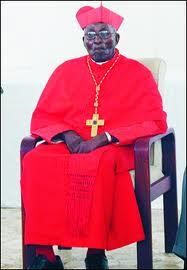
After living an active 12-year retirement, he was created a Cardinal Deacon in the Consistory of March 24, 2006 by Pope Emeritus Benedict XVI. The oldest of the new Cardinals, 87-year-old Cardinal Peter Poreku Dery at the time was seated in a wheelchair and was carried up the steps of St. Peter’s Square to the Pope.
Pope Benedict stood to place the Red Hat, called a Biretta, on Cardinal Dery’s head and caressed the Cardinal’s cheek after offering him the sign of peace. The last Cardinal created was 82-year-old French Cardinal Albert Vanhoye, a noted Biblical Scholar.
Archbishop Dery was Created Cardinal Deacon by Pope Benedict XVI in the Consistory of March 26, 2006.
A remarkable legacy of the Cardinal are manifested in the human potential he salvaged, nurtured and cared for. A dedicated, humble Priest he was and yet had time and charisma to pervade passion in the flock he led by giving them: Education – which he considered the gateway to economic development; Water – the source of all life and Healing – so his flock would survive to flourish.
His influence widely known as he has touched many lives including numerous number of his benefactors now serving as Clergy, Physicians, Professors, Educationist, Engineers, Journalists, Attorneys, Business Leaders and in various professions throughout the country and beyond.
Indeed, his great impact on the lives of many including William B. Coleman, a naturalized US citizen, born Ato Kwamina, “as a leader in the Young Christian Student Movement”, greatly inspired him to excel in life. He recounts that the Cardinal was a mentor, a father and a teacher, who opened his doors to all and guided him, and inspired his deep faith in God, and his belief in the potential of the human spirit.
Cardinal Dery’s fondness for youth and good works motivated Coleman to establish the Archbishop Dery Foundation in 2003 (now the Cardinal Dery Foundation) to further the good works of the Cardinal.
Cardinal Dery at the Maison Généralice of the White Fathers in Rome, Shortly after Receiving the Cardinal’s Red Biretta.
On May 6, 2010 during the Second Cardinal Dery Lectures at Christ the King Parish, Accra, Mrs. Rosaline Baatuolkuu Obeng-Ofori, said Peter, was a name meaning “A Rock” or a Foundation which is a real personification of Cardinal Dery. He was fearless, like a warrior. He was a person with many friends. No matter who you are, you will always feel safe in his presence. A strong believer in God. An exciting innovator. He is modest of his achievements. He believes strongly in family ties. He is a pillar to lean on and a real FOUNDATION STONE.
- a priest for 57.1 years
- a bishop for 47.8 years
- a cardinal for 2.0 years
- He died on Ghana’s 51st Independence anniversary on 6th March, 2008.
According Mrs. Obeng-Ofori, she first met Cardinal Dery, then Bishop of Wa in 1971 when “I went to secondary school at Jirapa. He visited us often and held retreats for us after which he would fete the students. We ate the best food after the retreats hence we always looked forward to his retreats. In 1976, while a student at Mount Mary College at Somanya, I was to pay some money for a trip that I was to undertake as part of my language training course abroad. I could not raise the amount as my parents were poor.”
“I wrote to Cardinal Dery, then Archbishop of Tamale and although he did not remember me personally except that I had passed through St Francis, he sent me the money by post. After College, I went to Tamale to thank him. We became friends, young as I was, insignificant as I was. Such is the confidence and trust he inspires in anybody he meets and radiates love to everybody he meets. Many are those who can recount thousands of such stories and their relationship with the Cardinal as I have experienced.
Religiously, Cardinal Dery’s childhood is characterized by a deep sense of spirituality as we are told he was the Assistant to his grandfather, Mwankuri Naa, who was a very powerful Fetish Priest in the Upper West. His quest for spiritual development endeared him to become one of the first converts to Catholicism, the first Dagao Priest, the First Dagao Bishop, the First Dagao Archbishop and of course the first Dagao Cardinal.
He developed many people to become Disciples of Christ in Ghana and beyond and many Priests and religious owe their Formation and Vocation to Cardinal Dery. Globally, Cardinal Dery advocated for a deeper knowledge of God in the use of the local language in Catholic worship. Today, we can pray to God in a language that we all understand instead of using Latin.
Politically Cardinal Dery was a selfless person. He was, indeed, a man for others. He critiqued governments irrespective of the risks involved. One remembers the time when The Catholic Standard was banned, and he knowing the value of the content of The Catholic Standard consistently fought for its revival. Many stories are told of his miraculous escapades from government officials who tried to harm him for his harsh critiques.
He was concerned about leadership and preached that leadership was nothing but “being there for others”. In his preaching and evangelization he emphasized the “common good” and said that beyond worship and proclamation of the word, the call to every Christian was to pursue the common good.
He developed structures to ensure the smooth running and active participation of the youth and the laity in the Church’s activities. Today, we have the Laity Council, the Ghana National Catholic Youth Council (GHANCYC) which co-ordinate all Lay and Youth activities in the Church. Most Ghanaians assumed international positions such as Vice President of World Federation of Catholic Youth (WFCY), President of International Movement of Catholic Students (IMCS)-Pax Romana, International Secretary of YCS, and so on. During his tenure as the Bishop-Chairman for the Laity Council, he worked very hard to set up the National Council of Catholic Women which today serves as the fulcrum round which education of women in the Church revolves. Internationally, he held prestigious positions including being the Father of four sessions of the Second Vatican Council. In this position, he advocated for many positive changes in the Catholic Church including the use of the local languages and the Africanisation of the Church.
Sociologically, his mission was “preferential option for the poor” as the basis of social justice and peace and what it means to promote them in society. To exemplify this, Cardinal Dery, in his practice as a Bishop in a Muslim dominated community in Northern Ghana, sent a Priest to Saudi Arabia to study the Muslim Religion because he believed that knowing and understanding Muslims and their way of worship would enable Catholics and other Christians in Northern Ghana to live in harmony with their fellow Muslims.
The Cardinal’s entire pastoral orientation was pivoted on his commitment to integral human development. He believed that God in His Infinite Goodness has endowed human beings with varied capacities that pre-dispose us to bringing about a condition of living devoid of hunger, disease, homelessness, poverty and oppression and build in their place harmony, peace, freedom, abundance, togetherness and love for each other.
Educationally, Cardinal Dery realized that EDUCATION was key to achieving meaningful socio-economic development in Ghana and beyond. He did vigorous fundraising locally and internationally to mobilize funds to educate the youth and other professionals for future leadership. Today, many can testify to the fact they were either supported by Cardinal Dery in the course of their education, or they attended an institution that he established or he formed them through his leadership programs in the Church.me For many years, Cardinal Dery served on the Ghana Education Service Council and helped to fashion out implementation plans for the various educational programs.
In the Upper West Region, he single-handedly undertook the establishment of many Schools and Training Institutes, some of which are among the best known educational institutions in the whole country. Among the Schools are St, Francis Xavier Minor Seminary, Wa in 1963 to train young men for the Priesthood. This School has churned out many graduates who are serving the nation and beyond as Doctors, Lawyers, engineers, Educationists, Priests, Journalists and many more professionals. Other Schools established by the Cardinal are St. Anne’s Vocational Institute at Nandom for Women; the Nandom Vocational School for Boys and St. Basilide’s Vocational School at Kaleo.
He did not only set up Schools and Institutes but also sent a number of young people to study in universities and Colleges Overseas. If one counts any ten outstanding professionals/public figures in Ghana, it would not be surprising to have at least five of them benefitting from Cardinal Dery’s educational support in one way or the other.
He provided opportunities for people to acquire skills and knowledge through non-formal programmes in order to bring appropriate knowledge to unfortunate, illiterate communities in developing countries. He set up the pioneer Credit Union in Jirapa in the Upper West Region, a concept which eventually spread to other parts of Africa. Jirapa has thus become the cradle of African Credit Unions, an institution that has contributed in no small ways to socio-economic development of Africa, especially for the rural and low income earners.
A gender Activist even before the UN and Beijing were conceived
He advocated for the empowerment of women even at a time when it was a taboo to see women as equal to men. He critiqued the negative cultural/ customary practices that discriminate against women and children. In his book, “Free Wives, Freed Women”, he advocated for the cancellation of bride price as he saw it as an enslavement of women.
He exemplified this by refusing to accept bride price for women who were related to him and for daughters of his Church leadership. Today, such women count among the most empowered, liberated and socially outstanding. I hope that the gender activists will take this up and see to the complete abolition of bride price in Ghana.
He saw the critical role that the educated woman can play in the socio-economic development of Ghana. He sent a number of girls to Schools and Colleges at his own expense. By his views and actions towards female education, the Cardinal associated himself with the position of the celebrated education expert, P. H. Coombs, who maintains that “…the education of women holds the key to all other elements on which the transformation of societies depends”.
If governments will pass legislation on gender equality and pragmatically put in place mechanisms to bridge the gender gap in all aspects of our social, political and economic endeavors, the world will certainly be a better place for us all.